Part 1: The Invisibility Cloak:
Those who are seriously into the Harry Potter franchise will definitely fantasize about the cloak of invisibility. The most considerable aid Harry ever got to move around unnoticed; The very skin of death itself that is gifted to the youngest and humble brother among the three. A bloody deathly hallow.


From such astonishing fiction, people always wanted to have that cloak. I mean, just think of the possibilities such material can bring in. Science has been in keen observation of the fictions that fantasize about the world. And to practically realize such stories to reality are one of the crazy aspects of scientists from time immemorial. Long live the scientific revolution.
What if I told you such a thing exists. No, not the one that Chinese guy shows (It is a hoax). But the idea is similar, and those are being developed in the laboratory scale only. In fact, it is a small meta lenses. When something is in front of it, the background radiation bends around it and falls into our eyes. So in effect, invisibility. (There are more technical and scientific explanations for it, Which will be a topic for tomorrow) .
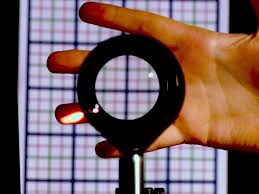
I want to introduce a new branch of science that works on materials such as the one I mentioned above. They are called “META MATERIALS.” Most of the condensed matter physics and nanotechnology all studies the chemistry of the material, but for metamaterials, it is the geometry that gives it a unique property.
Four famous equations unified electric and magnetic fields. And Maxwell was like, “Let there be light.” And with metamaterials, we are manipulating the light or, as we say, the Electromagnetic field. They are commonly referred to as a Negative Index of Refraction (NIR) materials. The exploration for manipulation of the EM waves with materials that are arranged in arrays started in the 19th century onwards. The idea of a negative refractive index was not a digestible theory until, in 1968, Veselago First theorized about the Negative Index of refraction Materials. A practical understanding of the NIR Metamaterial started to ignite the research interests in 1999 when John Pendry made the first left-handed metamaterial (Split ring). Metamaterials are some times referred to as left-handed materials as it travels opposite in the same direction after refracting.


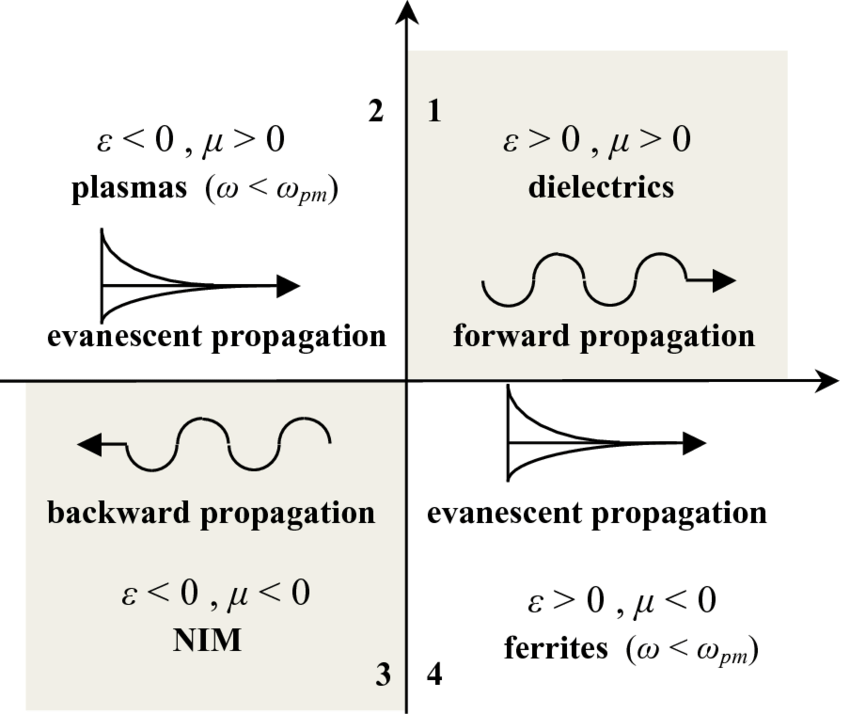
Demonstrating a unique phenomenon such as negative refractive index (n < 0) when metals and dielectrics are joined (stacked) together has triggered an interest in the metamaterial (MM) exploration. For a composite to project such a uniqueness based on its geometry of construction rather than its chemistry, metamaterials are a curiosity to explore further. Practical applications are in a wide range, Such as in defense, communication, Solar energy harvesting, Antennas, acoustics, and even in construction; metamaterials prove to be the next phase of advancement in technology. Many practical difficulties and sophistication are to be considered in designing a metamaterial. And all will vary according to the applications. The critical applications start with an absorber, whether it is a sensor or an energy harvester.
Though metamaterial research was highly active for the past two decades, most of the metamaterial absorbers (MMA) are tested in the gigahertz frequency range. Not only that, but very few practical MMA’s are reported; Since the slowly progressing fabrication technologies and limited resources. Recently, the exciting trend has shifted to the Terahertz regime, the small region that couldn’t be accessed due to the unavailability of natural materials that resonate in that energy bands. When in 2006, Hou-Tong Chen et al. demonstrated the first THz metamaterial absorber. Ever since, the unclaimed regime of the electromagnetic spectrum began to be explored. And more significant advantages were reported when two-dimensional materials like graphene, Vanadium dioxide, etc. began to be incorporated along with the MMAs.
As a Metamaterial researcher and enthusiast, I can say how it has dominated almost all fields, such as quantum mechanics, Electrodynamics plasmonics, photonics, quantum bits, antennas, metalenses, acoustics, and even the constructions of buildings also follow metamaterial patterns.
Thank you, J.K.Rowling, for the vision. But Veselago had it better.
 Science Defined