I still remember when I asked “Is there a way to prevent the loss while transferring electric current ?” in the lower classes. My teacher said that there is material with infinite conductivity due to pair formation of correlated pairs of electrons. It was the first time when I came across superconductivity.
Here I am going to give a little bit idea about superconductivity, which is not entirely explained by any developed theories.
Now, let’s look into some details. Initially, How we reach the superconducting state? In 1911, the Dutch physicist Heike Kamerlingh Onnes discovered this phenomenon while working in an element, Mercury. He noticed a sudden drop in the resistivity of Mercury below the temperature 4.2K. He named this phenomenon superconductivity. After this discovery, we found that materials become superconducting below the critical temperature (which is unique for different materials).
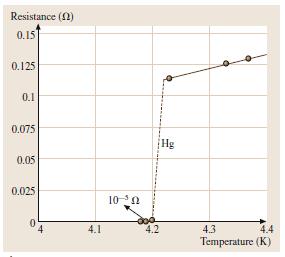
by Heike Kammerlingh Onnes
While we say zero resistivity or infinite conductivity regarding superconductors, actually, there remains a small resistivity called residual resistivity. The least known resistivity after the drop is in the order of magnitude 10-23 ohm and is measured by measuring the magnetic field produced by a superconducting ring by passing an electric current through it.
The research progressed on superconducting materials, and in 1933, Meissner and Oshsenfeld discovered another property: No magnetic induction, Magnetic inductance becomes zero inside a superconductor (Perfect Diamagnetism). If we go on increasing the surrounding magnetic field and, after a critical value, the superconducting state returns to the normal state. This effect is called the Meissner-Oshsenfeld effect.
These are the two basic properties we will encounter while we talk about the superconductor. Based on some characteristics we had classified the superconductors in to categories.
Type I and Type II Superconductors.
Type I superconductors
Superconductors that expel the magnetic field entirely until they become an entirely normal state. They were also known as pure superconductors. Most of the metals and their alloys in the dilute limit are Type I superconductors. There is a specified value of the magnetic field, which is applied to completely destroy the perfect diamagnetism.
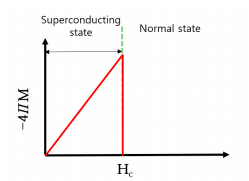
This is the magnetization curve of Type I superconductor. Above the critical field Hc, the material becomes normal, and the magnetization becomes zero at once.
Type II superconductor
Here there are two critical fields, lower Hc1 and Higher Hc2. The flux is completely expelled up to the field Hc1; therefore, in applied fields smaller than Hc1 material behaves like Type I superconductor below Hc. Above Hc1 flux partially penetrates the material until the Hc2 is reached. After Hc2, it becomes normal.
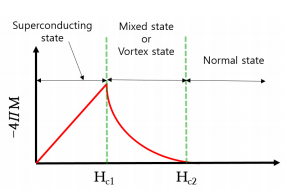
Between Hc1 and Hc2 the material is said to be in Mixed state. Here the Meissner effect is only partial. Magnetic flux partially penetrates the material in the form of microscopic filaments called vortices, hence called Vortex state.
Vortex consists of a normal core where the magnetic field is large and is surrounded by a superconducting region in which flows a persistent current which maintains the field within the core.
Theory
There came a lot of theories to explain these properties of superconductors, which I am not going into details, but none of them were exact. First London model came using equations and tried to describe these effects, and then came the Ginzburg-Landau Theory. But these theories all couldn’t explain the superconductivity phenomenon entirely. Then came BCS theory, which almost explained all the properties of Low-Tc superconductors, but after the discovery of the High-Tc superconductors BCS theory also is not enough to justify. Rigorous research is going on still now going on to understand the mystery behind the superconductivity phenomenon entirely. Many phenomena like these always challenges people who do theoretical research by denying every their models or conclusions by the discoveries of new experimental observations.
I hope every one could get familiar with superconductivity by reading this; I just explained the observed properties of superconductivity. The central working principle is like the formation of Cooper pairs, Energy gap, etc. are beyond the scope of this article.
 Science Defined
Such a pack of fascinating facts about super conductivity. It really urges us to go deep in to the theories related to Super conductivity.
LikeLike