We all may have studied that the spice called Pepper (Piper nigrum) is also known as ‘Black Gold.’ For an Indian, it might be curious to see how a common spice in our country had got such a supreme position in European markets. Let’s make a glance on the royal journey of Pepper from India to Europe.
From the time immemorial, Arabs, Egyptians, Persians, Greeks and Romans were such a font of Indian plant products such as spices, aromatic and medicinal plants. The traders arrived in our land using both inland caravans and sails, but the voyage to India was challenging. The discovery of the monsoon by Hippalus in the early 1st century AD was a great relief to the merchants, as they could travel more predictably to Malabar with the aid off South-West Monsoon and return by the North-East Monsoon winds.

The significant goods in the ships returning were spices, aromatic and medicinal plants. Among the spices, the Romans were attracted to the Malabar Pepper due to their unique taste and medicinal properties. Its piquant flavour was perfectly blended with the sweet Roman foods of that time, including Nero’s favourite snake served with peppered honey smeared on a piece of bread. Pepper was supposed to be an appetizer, sneeze inducer, antipyretic, and also believed as an aphrodisiac. Hence, in Roman markets, due to the increased demand and limited availability, an equal amount of gold was given to the Pepper bought due to which the tiny black seeds got the name ‘Black Gold.’ It is also known as Yavanapriya- the favourite of Yavans(Romans).
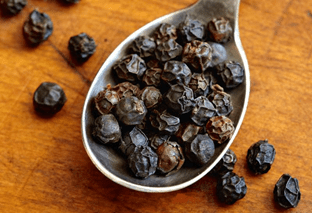
Within a short period, the European continent realized the significance of Pepper in diet and medicine. The Pepper became a high priced commodity, and the scientific world began to do researches on the chemical attributes of these small spherical drupes. Today, the black Pepper is recognized as an essential source of natural antioxidants having anti-carcinogenic activities. It also has anti-inflammatory action, antipyretic, antimicrobial, and antiperiodic activity. The black Pepper possesses immune enhancer ability and carminative properties too. Piperine is the major phytochemical in Pepper. The other major chemical compounds in Pepper include palmitic acid, myristic acid, lauric acid, beta-carotene, alpha-terpineol, acetophenone, nerol, nerolidol, 1,8-cineol,dihydrocarveol, citral, alpha-pinene and piperonal.
 Science Defined