PIR sensor(Passive Infra-Red sensor) is a sensor device used to sense motion, which functions by detecting the variation in the infrared radiation over a range. PIR sensor was invented by Herbert Berman back in 1920. It was a great invention in the field of movement detection.
Working principle:
All objects with a temperature above zero Kelvin, emit heat energy in the form of radiation, including human bodies. The pyroelectric sensor is made of a crystalline material that generates a surface charge when exposed to heat generated by radiation within the infrared regime. A PIR sensor can detect changes with the intensity of infrared radiation striking on it. This intensity is dependent on the temperature, surface characteristics of the material in front of the sensor. Objects of comparable temperature but different surface properties can also have a special infrared pattern, and thus, moving them concerning the background may also trigger the detector.

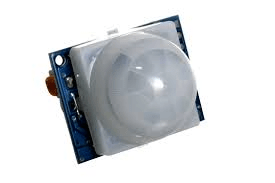
The PIR sensor consists of two main parts: A pyroelectric sensor and a special lens called Fresnel lens which focuses the infrared signals into the pyroelectric sensor. The most common models have numerous Fresnel lenses or mirror segments, an effective range of about 10 meters, and a field of view less than 180°. Some larger PIRs are made with single segment mirrors and may sense changes in radiation over 30 meters.
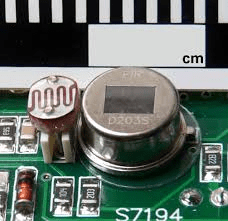
A Pyroelectric Sensor has two rectangular slots made of a material that allows the infrared radiation to reach. Behind these are two separate infrared sensor electrodes, one responsible for creating a positive output and the other, a negative output. The reason for that is that we are looking for a change in IR levels and not ambient IR levels. The two electrodes are wired up so that they cancel each other out. But when a warm body sort of human, or animal enters the region, it first intercepts one half the PIR sensor, which causes a positive differential change between the two halves. When a smooth surface enters the sensing area, the reverse happens, the sensor generates a negative differential change. The corresponding pulse of signals leads to the sensor setting its output pin high.
Let’s now have a look at its practical applications:
Automated lights
This is a simple application of PIR sensor. We can automate any light or electric equipment by a PIR sensor.
The circuit will work only when a person enters the room. The circuit consists of a PIR sensor, relay module, and some electronic chips. When a person enters the room, the PIR will produce a signal and give it to the electronic chip. The electronic chip will provide a signal to the relay module. This circuit helps us to save a lot of energy.
Security Applications
This is another simple application of PIR sensor. We can use this sensor in a burglar alarm. But in this case, the placement of the sensor is important. The sensor should be kept at a place where no one can detect the sensor at first sight. The sensor will be connected to an alarm circuit which triggers when the sensor gives a signal.
That’s all for this post. Stay tuned for more posts on exciting technologies!
 Science Defined