Our planet has been around for 4.5 billion years, the history of our planet and how it evolved to be what it is, has always been a question that intrigued humans. How different earth would have been 60,000 years ago? What would earth be like 10,000 years from now? Like some of us keep diaries to keep track and revisit memories, earth has a diary of its own – the Ice sheets. It documents and records the changes it has seen in these ice sheets. Like glaciers, ice sheets are formed when the snowfall accumulates, when the annual snowfall is higher than the annual snow melt. Over thousands of years, layers of ice are formed which can go as deep as 3 km.
Each layer of ice sheet is unique in terms of its chemistry and structure. They reflect the climatic conditions of the time period at which the ice sheets were formed, they capture particles and dissolved chemicals and trap air bubbles. They can tell us how cold or hot it was, how much it snowed and rained, if there was a volcanic eruption or not or what gases were in the atmosphere back then. To be concise, they can tell you pretty much how the earth evolved to be what it is and might as well predict how the earth would be a few hundred years from now.
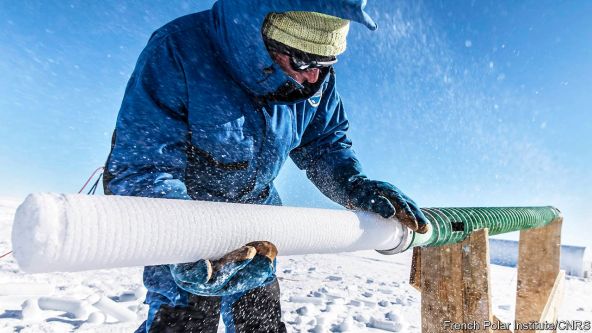
So, how do we read this diary and what do they tell us? Scientists drill the ice sheets to procure ice cores which are cylinders of ice, these are then cut and analysed by teams of scientists. First step is to figure out how old the layer of ice is. Ice cores are easy to date, they have annual layers like the growth rings on trees, which are created due to seasonal differences. But as we go down, the layers become harder to see as they grow more and more compact, burdened by the weight of ice above them. Scientists have other methods of dating as well using geochemistry, layers of ash and electrical conductivity.
One of the important paleoclimatic factors is precipitation rate, it is an essential parameter for studying past climate. Scientists figure this out by measuring the thickness of the annual layers. Besides telling us how wet the rainy seasons were, ice cores can also tell us how warm the summers were in the past. During the summer, the snow on the surface melts, the released water then percolates down through the snow pack and forms bubble free ice layers in the ice core called melt layers. More melt layers indicate warmer summer temperature.
Ice cores, as you know trap past atmospheric gases. Air gets trapped at the base of the firn layer, but when the compacted ice turns into ice, the air is trapped in bubbles. These bubbles are then extracted by melting, crushing or grating the ice in a vacuum. They can tell us about the composition of atmospheric gases in the past, which can then be used to estimate past temperature.
Apart from temperature and precipitation rate, the ice cores can also give us information about volcanic eruptions. For instance glass shard layers from volcanic eruption or tephra were preserved in the ice cores from Greenland. But during large eruptions, the tephra spewed out gets scattered all over and these may be preserved in ice cores at different geographical locations. In such cases, the geochemical nature of tephra is analysed to check if they are identical which implies a time synchronous event i.e, both samples are related to the same volcanic eruption.
Ice cores are more than a window to the past, they can provide a glimpse to the future. Studying how climate changed in the past can help in predicting how it might change in the future. Reconstructing data from the ice cores have given us insights on rapidly changing climate and it can help us make better and more informed decisions to slow down climate change.
Source:
 Science Defined