The story behind cold fire may felt like fiction. Because you know, it’s cold fire. It’s the life story of an alchemist.
Henning Brand was an alchemist who lived in Germany from 1630 AD to 1692 AD. He was serving as a junior officer in the military and returned to research. Like other Alchemists, his goal was to find the Philosopher’s Stone. The Philosopher’s Stone is capable of making cheap (e.g. lead) metal into precious metal (e.g., silver and gold).
However, he wasn’t having enough money for his research. The solution he found was to marry twice and use the money obtained as a dowry for research! Crazy guy, right? The crazy part is yet to come. His experiments were based on Alum, Saltpeter (Potassium Nitrate), and Boiled urine.
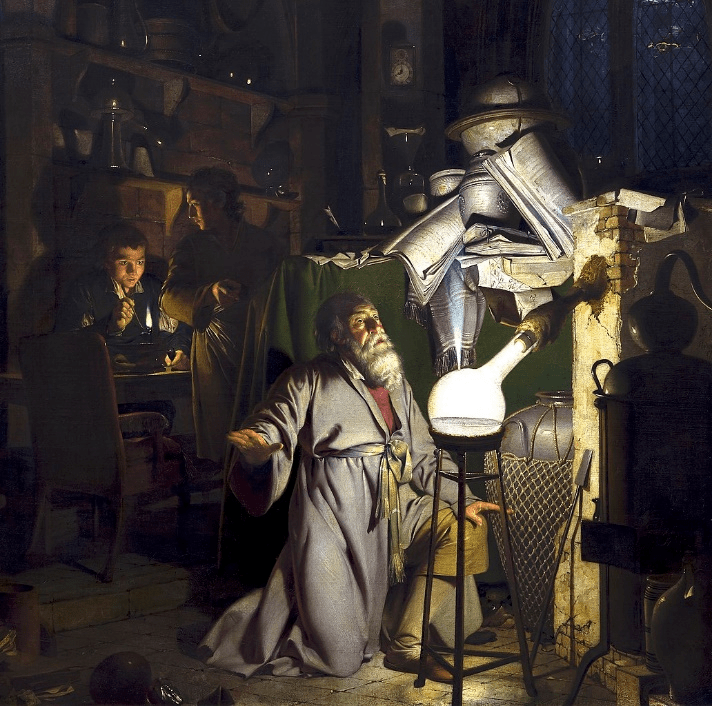
He collected 5500 liters of urine and boiled it. The residue heated again until complete water was evaporated. The residue decomposed inside the retort. Something powerful was going on inside. The retort is full of sparkling smoke. The smoke that lights up like a blazing fire. An unknown substance fell out of the retort and caught fire. The flames exploded!
Brand was brave. He kept some of the liquid in a jar closed it tight and kept it cool. The liquid transformed into a solid piece of wax. It shone like a coin. Like a ‘cold fire‘ going out. In the dark, that brightness was so clear. He gave it a name. The light, to be the bearer of light. That is “Phosphorus” (Greek). He could never make gold or silver. Even though he failed in that mission, he felt that he had received some divine substance. He kept his discovery secret. It was sold to some people. The recipe for making it was bought and handed over to some (Just alchemist’s things).
In fact, he was the first to extract an element in the world. The discovery dates back to 1669 AD.
What was the chemistry behind Brand’s discovery?
Human urine contains Sodium phosphate. There are also organic compounds that contain carbon. When the urine residue is strongly heated, it decomposes phosphate and give oxygen. The oxygen then combines with the carbon from the organic compounds and form carbon monoxide. Phosphorus in phosphate became isolated through this. Gaseous phosphorus changes to cold liquid phosphorus below 280 ° C, and it freezes into solid phosphorus near 44°C.
The quality of the experiments at that time was very poor so when he heat 5500 liters of urine he gets only 120 grams of phosphorus. The white phosphorus thus obtained is polished, giving out the light. Polishing happens because it mixes with atmospheric oxygen. This is the case of white phosphorous, however the red phosphorus, another allotropic form of phosphorus, is not so bright.
 Science Defined