Hey guys, are you excited while reading this heading??
If you are excited, we will just go to finding the corollary of our excitement. So first, we are looking for how Gold (like other metals) can have a beautiful color.
Why is Gold Yellow?
The color of metals can be explained by band theory, which assumes that overlapping energy levels form bands.
The mobility of electrons exposed to an electric field depends on the width of the energy bands and their proximity to other electrons. In metallic substances, empty bands can overlap with bands containing electrons. The electrons of a particular atom are able to move to what would normally be a higher-level state, with little or no additional energy. The outer electrons are said to be “free” and ready to move in the presence of an electric field.
Some substances do not experience band overlap, no matter how many atoms are in close proximity. For these substances, a significant gap remains between the highest band containing electrons (the valence band) and the next band, which is empty (the conduction band). As a result, valence electrons are bound to a particular atom and cannot become mobile without a significant amount of energy being made available. These substances are electrical insulators. Semiconductors are similar, except that the gap is smaller, falling between these two extremes.
The highest energy level occupied by electrons is called the Fermi energy, Fermi level, or Fermi surface. If the efficiency of absorption and re-emission is approximately equal at all-optical energies, then all the different colors in white light will be reflected equally well. This leads to the silver color of polished iron and silver surfaces.
The efficiency of this emission process depends on selection rules. However, even when the energy supplied is sufficient, and an energy level transition is permitted by the selection rules, this transition may not yield appreciable absorption. This can happen because the energy level accommodates a small number of electrons.
For most metals, a single continuous band extends through to high energies. Inside this band, each energy level accommodates only so many electrons (we call this the density of states). The available electrons fill the band structure to the level of the Fermi surface, and the density of states varies as energy increases (the shape is based on which energy levels broaden to form the various parts of the band).

If the efficiency decreases with increasing energy, as is the case for Gold and copper, the reduced reflectivity at the blue end of the spectrum produces yellow and reddish colours.
Gold is so malleable that it can be beaten into gold leaf less than 100 nm thick, revealing a bluish-green colour when light is transmitted through it. Gold reflects yellow and red, but not blue or blue-green. The direct transmission of light through the metal in the absence of reflection is observed only in rare instances.
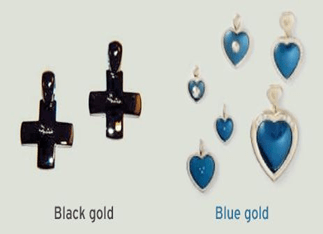
And Gold can also be colored by creating surface oxide layers. Because Gold does not oxidize in its pure form, base metals have to be added to create blue, brown, and black Gold. The “Hearts” collection, in blue Gold, is by Ludwig Muller of Switzerland.
Now we are going to the topic of our interest.
Is Gold always yellow…??
We will be answering this question with the scope of Nanoscience using the nanoparticle concept.
A nanoparticle is a small particle that ranges between 1 to 100 nanometres in size. Undetectable by the human eye, nanoparticles can exhibit significantly different physical and chemical properties to their larger material counterparts.
Gold nano particles are versatile materials for a broad range of applications with well-characterized electronic and physical properties due to well-developed synthetic procedures. Also, their surface chemistry is easy to modify. These features have made gold nano particles one of the most widely used nano materials for academic research and an integral component in point-of-care medical devices and industrial products worldwide. Our broad offering of gold nano particles, accessible to the global research community, serves to increase their adoption in high-technology applications.
Gold nano particles’ interaction with light is strongly dictated by their environment, size, and physical dimensions. Oscillating electric fields of a light ray propagating near a colloidal nano particle interact with the free electrons causing a collective oscillation of electron charge that is in resonance with the frequency of visible light. These resonant oscillations are known as surface plasmon. For small (~30nm) mono disperse gold nano particles, the surface plasmon resonance phenomenon causes absorption of light in the blue-green portion of the spectrum (~450 nm) while red light (~700 nm) is reflected, yielding a vibrant red color. As particle size increases, the wavelength of surface plasmon resonance related absorption shifts to longer, redder wavelengths. Red light is then absorbed, and blue light is reflected, yielding solutions with a pale blue or purple color.
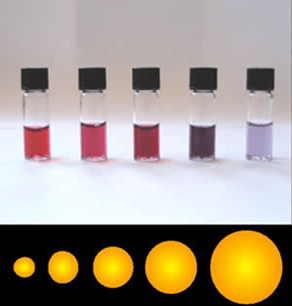
The diameter of the gold nano particles determines the wavelengths of light absorbed. The colors in this diagram illustrate this effect.
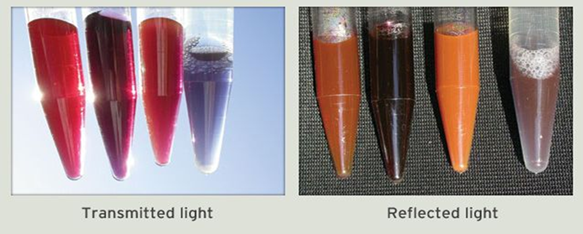
Dispersions of discrete gold nanoparticles in transparent media provide a fascinating range of colors, only recently exploited in the manufacture of paints and coatings. The shape of the particles and the viewing conditions determine the color we see. The gold particles in the test tubes on the left are shown in transmitted light, while the image on the right shows the same gold nanoparticles viewed in reflected light.
As particle size continues to increase toward the bulk limit, surface plasmon resonance wavelengths move into the IR portion of the spectrum, and most visible wavelengths are reflected, giving the nanoparticles transparent or translucent colour. The surface plasmon resonance can be tuned by varying the size or shape of the nanoparticles, leading to particles with tailored optical properties for different applications.
This phenomenon is also seen when excess salt is added to the gold solution. The surface charge of the gold nanoparticle becomes neutral, causing nanoparticles to be aggregate. As a result, the solution color changes from red to blue. For minimizing the aggregation, the versatile surface chemistry of gold nanoparticles allows them to be coated with polymers, small molecules, and biological recognition molecules. This surface modification enables gold nanoparticles to be used extensively in chemical, biological, engineering, and medical applications.
I hope all of you could get the answer to your curiosity about the question I asked. I just tried to make you think about a topic that is familiar to you.
 Science Defined